Keyholder Response Procedures –
For many Halifax businesses, security planning traditionally focused on preventing break-ins through locks, alarms and physical barriers. Whilst these measures remain essential, increasing attention is now being placed on what happens after an alarm activates. Specifically, businesses are reviewing whether their current keyholder response arrangements are still appropriate for modern security risks.
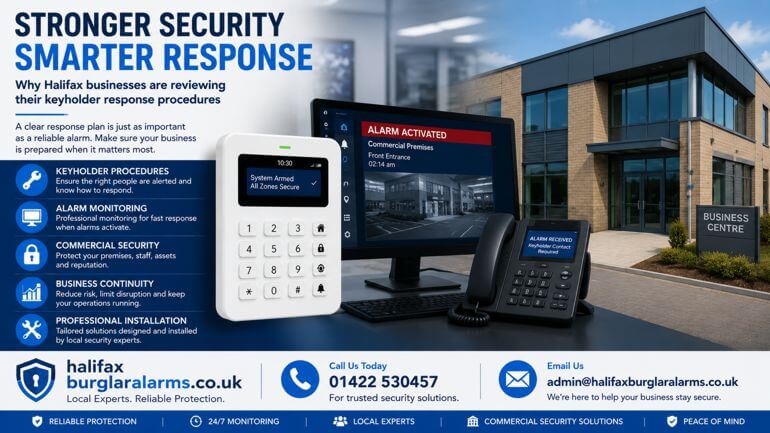
A keyholder response procedure determines who is contacted when a burglar alarm activates outside normal business hours. In many organisations, this responsibility falls on business owners, managers or senior staff members who are expected to attend site if an alarm activation occurs.
Historically, this arrangement was considered normal practice. However, many businesses are now recognising that expecting employees to attend potentially vulnerable premises during the early hours of the morning may not always be the safest or most effective approach.
Commercial premises across Halifax vary significantly, from town centre offices and retail units to industrial estates, warehouses and manufacturing facilities. Each environment presents different security challenges and may require different response procedures following an alarm activation.
One concern involves uncertainty surrounding alarm activations. When a call is received at 2am, the individual responding rarely knows whether the activation was caused by a genuine intrusion, accidental activation, equipment fault or environmental factor. Arriving at a dark commercial property without clear information can place keyholders in an uncomfortable position.
For this reason, many businesses are reviewing how alarm activations are managed and whether their existing procedures remain fit for purpose. Modern monitored alarm systems can provide more structured escalation procedures, ensuring activations are handled consistently and efficiently.
Business continuity is another important consideration. If keyholder responsibilities rest with only one or two individuals, holidays, sickness or staff changes can create gaps in coverage. A documented and regularly reviewed response procedure helps ensure continuity throughout the year.
Large commercial premises often require multiple authorised keyholders. This helps ensure somebody is available when required whilst reducing reliance on individual members of staff. Contact details should be reviewed regularly to ensure information remains accurate and up to date.
Many Halifax businesses are also considering how alarm systems integrate with wider security policies. Security should not be viewed purely as a technical issue. Effective procedures, staff awareness and clear escalation routes are equally important components of a successful security strategy.
False alarms can create operational disruption if response arrangements are poorly managed. A clearly documented process helps reduce confusion and ensures activations are handled appropriately. Staff should understand their responsibilities and know exactly what actions are expected following an activation.
Industrial premises often face additional challenges due to site size and complexity. Large buildings, multiple access points and extensive storage areas can make investigations more difficult. Security planning should reflect the specific risks associated with the premises.
Insurance providers may also expect businesses to maintain appropriate security procedures, particularly where monitored alarm systems are installed. Reviewing keyholder arrangements forms part of demonstrating a responsible approach to risk management.
Alarm maintenance plays an important role in supporting effective response procedures. A well-maintained alarm system reduces the likelihood of unnecessary activations whilst helping ensure genuine incidents are identified quickly.
As businesses continue to adapt to changing risks, security procedures must evolve accordingly. Reviewing keyholder response arrangements is a practical exercise that can improve preparedness, support staff safety and strengthen overall security management.
For Halifax businesses, the objective is not simply to receive an alarm notification. The goal is to ensure there is a clear, reliable and effective process for dealing with activations whenever they occur. Modern burglar alarm systems provide the foundation, but robust response procedures ensure that security measures deliver their intended value when needed most.