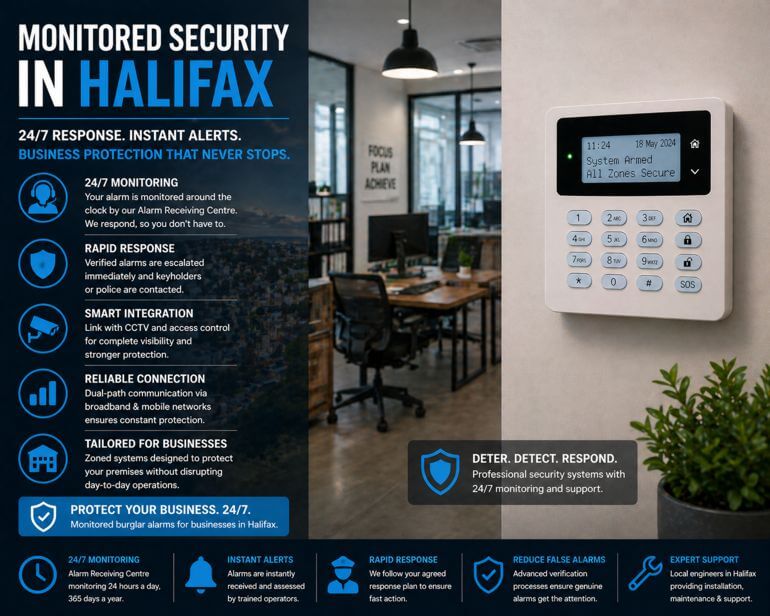
Monitored Burglar Alarms –
For businesses in Halifax, protecting premises outside of operating hours is one of the biggest security challenges. While standard burglar alarms provide an audible deterrent, they rely on someone being nearby to respond. For many commercial environments, particularly those left unattended overnight or at weekends, this is not enough. This is where monitored burglar alarm systems become essential.
A monitored system is connected to an Alarm Receiving Centre (ARC), where trained operators monitor incoming alarm signals 24/7. When an alarm is triggered, the signal is immediately transmitted to the ARC, where it is assessed and escalated as required. This ensures that every activation receives a response, even if no one is on-site.
For Halifax businesses, this is particularly important in sectors such as retail, warehousing and offices where valuable stock, equipment or sensitive data may be present. Without monitoring, an alarm sounding in an empty building may go unnoticed, allowing intruders more time to cause damage or theft.
One of the key advantages of monitored systems is rapid response coordination. Once an alarm is verified, the ARC can contact keyholders or, where appropriate, escalate the situation further. This structured response reduces uncertainty and ensures that incidents are handled efficiently.
Verification is an important part of monitored alarm systems. Many setups incorporate additional features such as sequential confirmation or integration with CCTV to reduce the likelihood of false alarms being escalated unnecessarily. This helps maintain system credibility and avoids disruption.
In Halifax commercial premises, where multiple alarm activations can lead to complacency, this level of control is essential.
Dual-path communication is another critical feature. Monitored systems typically use two independent communication methods, such as broadband and mobile networks, to ensure that signals are transmitted reliably. If one path fails, the other continues to operate, maintaining connection to the ARC at all times.
System design remains a fundamental factor. Monitored systems must be properly configured, with appropriate zoning and detector placement to ensure accurate and meaningful activations. Poorly designed systems can result in frequent false alarms or missed detections.
Zoning allows businesses to identify exactly where an alarm has been triggered, enabling a more targeted response. In larger Halifax premises, this reduces disruption and improves efficiency when dealing with incidents.
Integration with other security systems enhances the effectiveness of monitored alarms. When combined with CCTV, access control or lighting systems, the overall security setup becomes more robust and responsive.
Visible deterrents still play a role. External sounders and signage indicate that the premises are protected by a monitored system, which can discourage potential intruders before they attempt entry.
Maintenance is essential to ensure that the system remains reliable. Regular servicing ensures that all components are functioning correctly and that communication paths are operating as expected.
Staff awareness is also important. Employees should understand how the system operates, including arming and disarming procedures, as well as how monitored responses are handled.
Documentation supports both compliance and system management. Records of maintenance, activations and system changes help ensure that the system continues to meet the needs of the business.
For higher-risk environments, monitored systems may also be linked to additional security measures, providing a more comprehensive approach to protection.
Ultimately, monitored burglar alarms provide continuous protection and peace of mind, ensuring that every activation is acted upon. For businesses in Halifax, this means greater security, faster response and reduced risk — even when the premises are unoccupied.
Investing in a monitored system is not just about compliance; it is about ensuring that your business is protected at all times, with a reliable response when it matters most.